I think a lot of AI products accidentally teach users to stop coming back.
Not because the product is bad. Not because the models are bad. Not even because the price is too high.
Usually it is because the pricing shape is wrong.
You see it when someone signs up, uses the product heavily for a day or two, hits a limit much earlier than they expected, then quietly disappears.
They do not always cancel immediately. Sometimes they stay subscribed. But the product falls out of their routine. And once that happens, churn is mostly just a matter of time.
This tweet got me thinking about that again:
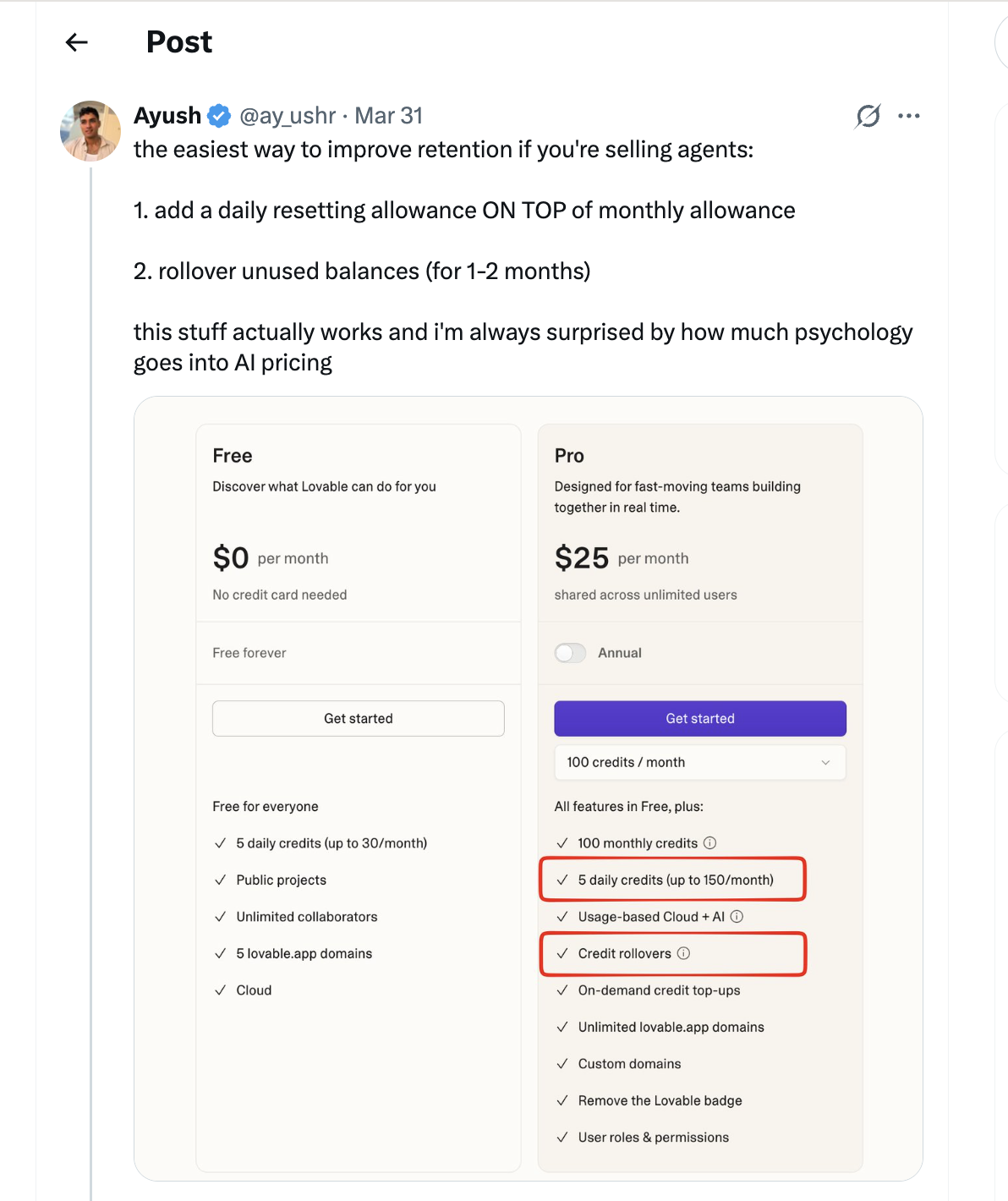
Original tweet that sparked this post.
I like the point because it is simple and it matches what a lot of people are already running into.
Most AI usage is not smooth enough for a single monthly bucket.
People use AI in bursts. They have a heavy day, then a lighter week, then another heavy day when something at work breaks or a deadline lands. But a lot of products still price it like old SaaS: pay monthly, get one allowance, see you next billing cycle.
That is where things start going wrong.
The problem with one monthly wall
If a user burns through their allowance on day 4 or day 9, the product has basically told them one thing:
come back later.
Maybe next month. Maybe after an upgrade. Maybe after buying more credits.
Whatever the exact path is, the product has interrupted the habit.
That matters more than teams think. Retention is not just about whether the user likes the product. It is also about whether the product still fits into their week after the first burst of usage.
When the limit is one hard monthly wall, three things usually happen.
- some users stop using the product till the next cycle
- some start rationing usage and using it less often than they want
- some decide the pricing feels off, even if they cannot explain exactly why
None of that helps retention.
The part that is mostly psychology
I do not mean that in a fluffy way. I just mean people react to the shape of a limit, not only the number itself.
“1000 per month” and “30 per day plus some carryover” can land very differently even if the economics are not that far apart.
One feels like a bucket you might accidentally waste. The other feels more like a product you can keep returning to.
That is why daily resets are interesting.
If someone runs out and the answer is “resets tomorrow” or “after 5 hours”, that feels annoying, but normal. If the answer is “wait three weeks”, that feels like being pushed out of the product.
The same goes for rollover. When all unused value disappears at the boundary, people notice. They might not write angry tweets about it, but it still changes how fair the plan feels.
Small rollover fixes some of that. Not infinite rollover. Just enough that a quiet week does not feel like lost money.
The real pricing question
I think a lot of teams ask the wrong first question.
They ask:
how much should we include in the monthly plan?
But the more useful question is:
what kind of allowance keeps the user in the habit of coming back?
Those are not the same question.
If you start with the second one, you usually end up with some combination of:
- a recurring base plan
- a shorter reset window on top
- a small rollover buffer
- some way to handle spikes without breaking the whole experience
That spike path matters a lot too. If a customer has one unusually heavy week, you usually do not want the only options to be “upgrade everything” or “stop using the product.” Top-up credits or overage are often a better release valve.
What this means in practice
For AI apps, I think the job of pricing is not just to capture value. It is also to preserve product rhythm.
The user should know:
- what they can do right now
- what happens when they run out
- when access comes back
- whether unused value disappears or carries a bit
Once those things are vague, pricing starts to feel arbitrary.
That is part of why I like having reset windows and resetsAt as actual product
surface, not hidden billing logic. If the limit exists, the user should be able
to understand it inside the app.
What this looks like in Owostack
This is also why Owostack ended up with resets, credits, overage, and shared balances as first-class pieces.
The codebase already has the primitives for the kind of pricing this tweet is talking about:
- included quotas
- hourly, daily and monthly reset intervals
- prepaid credit systems and credit packs
- overage that can block or charge
check()responses that includeresetsAt
So instead of forcing everything into one monthly counter, you can shape access in a way that matches how AI products are actually used.
Even a simple plan like this changes the feel of the product:
const agentRuns = metered("agent-runs", { name: "Agent Runs" });

plan("pro", {
  name: "Pro",
  price: 2500,
  currency: "USD",
  interval: "monthly",
  features: [
    agentRuns.limit(40, {
      reset: "daily",
    }),
  ],
});
And once the user hits the limit, the app can tell them exactly what is going on:
const access = await owo.check({
  customer: "user_123",
  feature: "agent-runs",
});

if (!access.allowed) {
  return {
    message: `You are out for now. Resets at ${access.resetsAt}.`,
  };
}
That is still a limit. But it is a limit the user can live around.
If you also want a softer overflow path, you can layer in credit packs or chargeable overage instead of turning every spike into a forced plan change.
The point
If your AI product has a retention problem, pricing is one of the first places I would look.
Not only price level. Price shape.
A lot of products are still selling AI with monthly logic that made more sense for older SaaS. I do not think that holds up very well once usage gets spiky and cost starts following usage more closely.
So yeah, I think this tweet is right.
One monthly allowance on its own is often too blunt. Shorter reset windows help. Small rollover helps. And giving users a path through spikes helps too.
That stuff sounds small, but it changes whether the product feels like something you can keep using, or something that keeps telling you to come back later.